We Need to Talk.
2025 is ending, and the cybersecurity industry is patting itself on the back for another year of “innovation.” More tools. More frameworks. More three-letter acronyms that sound important but mean nothing to the business owner trying to protect their company with a $500/month IT budget.
Meanwhile, 68% of data breaches involve a human element—meaning your people, not just your technology, are the target (Verizon 2024 Data Breach Investigations Report). And when attackers succeed? The median loss from a ransomware or extortion attack is $46,000 (FBI Internet Crime Complaint Center, cited in Verizon 2024 DBIR)—an amount that can cripple a small business.
Let that sink in.
While the industry celebrates billion-dollar valuations and enterprise deals, small businesses are being told they’re “not doing enough”—by the same people selling them solutions they can’t afford, implement, or understand.
So here’s our letter to 2026. Not from consultants. Not from vendors. From the people who’ve spent over a decade working with organizations that don’t have dedicated security teams, unlimited budgets, or the luxury of hiring a CISO.
This is what needs to change.
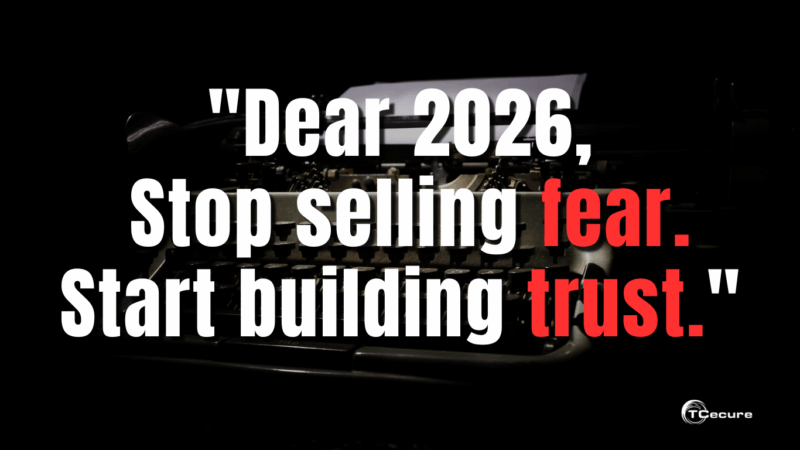
1. Stop Selling Fear. Start Building Trust.
What’s Broken:
The cybersecurity industry runs on fear. Every headline is a catastrophe. Every sales pitch starts with “you’re already compromised.” Every vendor is peddling the idea that without their specific tool, you’re one click away from total annihilation.
And you know what that does to small businesses? It paralyzes them.
When everything is an emergency, nothing is. When every vendor says their solution is “critical,” business owners stop listening entirely. They tune out, shut down, and cross their fingers that they’re too small to be a target.
Spoiler: They’re not.
What Needs to Change:
In 2026, we need to stop weaponizing fear and start building trust.
That means:
- Honest conversations about what threats are actually likely for a 15-person accounting firm (spoiler: it’s not nation-state actors)
- Clear priorities instead of 47-point checklists that make security feel impossible
- Transparency about what’s realistic with limited resources instead of shaming people for not having enterprise-grade infrastructure
Small businesses don’t need to be scared into action. They need to be equipped for it.
2. Make Compliance Stop Feeling Like Punishment
What’s Broken:
For small businesses, “compliance” has become a dirty word. It’s expensive. It’s confusing. And worst of all, it often feels disconnected from actual security.
You can check every box on a compliance audit and still get breached the next week. Why? Because compliance frameworks were designed for enterprises—and then slapped onto organizations that don’t have the staffing, budget, or infrastructure to support them.
The result? Small businesses either:
- Spend money they don’t have on consultants who hand them 200-page policy documents they’ll never read, or
- Ignore compliance entirely and hope no one notices
Neither option makes anyone safer.
What Needs to Change:
In 2026, compliance needs to become a roadmap—not a ransom note.
That means:
- Right-sized frameworks that don’t assume every organization has a 10-person security team
- Practical guidance on what actually matters vs. what’s just box-checking
- Affordable pathways to compliance that don’t require a $50K retainer before you even start
Compliance should be a tool for getting secure—not proof that security is only for people who can afford it.
3. Kill the Jargon. Speak Human.
What’s Broken:
Try Googling “small business cybersecurity tips.” Go ahead. We’ll wait.
What you’ll find: articles packed with terms like “zero-trust architecture,” “endpoint detection and response,” “SIEM integration,” and “next-gen firewalls.”
Now imagine you’re a business owner who just wants to know if your employees’ passwords are strong enough.
This is the disconnect.
The cybersecurity industry speaks a language that 90% of its audience may not understand—and then acts surprised when people don’t take action.
What Needs to Change:
In 2026, we need to speak like humans to humans.
That means:
- Explaining risks in terms of business impact, not technical specs
- Offering solutions that don’t require a CompTIA cert to understand
- Meeting people where they are instead of assuming they know what “phishing simulation platforms” do
If your target audience is small business owners, write for small business owners—not for the cybersecurity conference circuit.
4. Affordable Doesn’t Mean “Cheap” (And Small Doesn’t Mean “Not Worth It”)
What’s Broken:
Here’s the dirty secret of the cybersecurity industry: most vendors don’t think small businesses are worth their time.
Why? Because the math doesn’t work. It takes the same amount of effort to onboard a 20-person company as it does a 2,000-person one—but the 2,000-person company pays 100x more.
So small businesses get:
- Handed off to junior staff
- Sold one-size-fits-all tools that don’t fit
- Told to “just use the free version” of enterprise solutions that weren’t designed for them in the first place
And when something goes wrong? They’re blamed for “not investing enough in security.”
What Needs to Change:
In 2026, the industry needs to build for small businesses—not just resell enterprise tools at a discount.
That means:
- Purpose-built solutions that are affordable and effective
- Scalable support that doesn’t require a $10K/month retainer
- Respect for the fact that protecting a 15-person company is just as important as protecting a 15,000-person one
Small businesses aren’t a training ground for your junior consultants. They’re the backbone of the economy. Treat them like it.
5. Automation Isn’t the Enemy—It’s the Equalizer
What’s Broken:
For years, small businesses have been told they need to “do more with less.” Hire a security team (with what budget?). Monitor logs 24/7 (with what staff?). Run vulnerability scans monthly (with what tools?).
It’s exhausting. And it’s impossible.
But here’s the thing: technology can actually level the playing field—if it’s designed to.
The problem isn’t automation. It’s that most “automated” security tools still require a trained professional to configure, monitor, and interpret. That’s not automation. That’s just shifting the workload.
What Needs to Change:
In 2026, automation needs to actually work for people without security teams.
That means:
- Tools that set up in minutes, not months
- Dashboards that show what matters, not everything
- Alerts that tell you what to do, not just that something happened
The future of small business security isn’t hiring more people. It’s making technology smart enough that you don’t have to.
What Gives Us Hope
Look, we wouldn’t still be doing this work if we didn’t believe things could change.
And here’s what gives us hope heading into 2026:
- Small businesses are getting louder.
They’re tired of being talked down to. They’re demanding better. And vendors are starting to listen. - The industry is slowly waking up.
More companies are realizing that “affordable” and “effective” aren’t mutually exclusive. Innovation is happening—not just in enterprise security, but in solutions built specifically for resource-constrained organizations. - The conversation is shifting.
From “you’re doing it wrong” to “here’s how to do it better.” From fear to empowerment. From complexity to clarity. - We’re seeing results.
Organizations that were told they’d need $100K+ to “get secure” are doing it with a fraction of that—because they’re focusing on what actually matters instead of checking boxes.
Progress is happening. It’s just not happening fast enough.
So Here’s Our Commitment to 2026
At TCecure, we’re done waiting for the industry to catch up.
In 2026, we’re committing to:
–No jargon-heavy pitches. If we can’t explain it in plain English, we won’t say it.
–No fear-mongering. We’ll tell you what’s realistic, not what’s catastrophic.
–No one-size-fits-all solutions. If it doesn’t work for your organization, we’re not selling it.
–Real support for real budgets. Effective security shouldn’t cost more than your annual revenue.
We’re building for the organizations everyone else is ignoring. The 10-person nonprofits. The 25-person manufacturers. The 50-person healthcare practices.
You deserve better than hand-me-down enterprise tools and consulting retainers you can’t afford.
And in 2026, we’re making sure you get it.
What You Can Do Right Now
If you’re a small business owner reading this and thinking, “Okay, but what do I actually do?”—here’s where to start:
1. Stop Trying to Do Everything at Once
You don’t need to solve all your security problems today. Pick one thing. Start there. Build momentum.
Recommended first step: Multi-factor authentication (MFA) on every account that allows it. It’s free, fast, and blocks 99% of automated attacks.
2. Get Clear on What You’re Actually Protecting
Not every asset needs Fort Knox-level security. Figure out what data, systems, and processes are actually critical to your business. Protect those first.
3. Ask Questions—And Demand Real Answers
If a vendor or consultant can’t explain their solution in terms you understand, that’s their problem, not yours. Don’t let anyone make you feel dumb for asking “why?”
4. Find Partners Who Actually Get It
Look for consultants, tools, and resources that are built for small businesses—not just marketed to them. You’ll know the difference when you see it.
5. Talk to Someone Who Won’t Sell You Something You Don’t Need
Seriously. If you’re overwhelmed, stuck, or just trying to figure out where to start—reach out. We’re here for real conversations, not sales pitches.
📧 info@tcecure.com
—
The Bottom Line
2025 proved something we already knew: small businesses are the backbone of the economy—and the most underserved segment in cybersecurity.
2026 can be different. But only if the industry stops treating “small” like it means “not worth it.”
To the vendors: Build for the people who need you most—not just the ones who can pay you most.
To the consultants: Speak like a human. Educate genuinely. Stop gatekeeping knowledge behind certifications and retainers.
To the small business owners: You’re not behind. You’re not failing. You’re just working with a system that wasn’t designed for you.
And we’re here to change that.
Here’s to 2026. Let’s make it the year cybersecurity finally works for everyone.
Ready to talk about your security without the sales pitch? Let’s connect: info@tcecure.com